
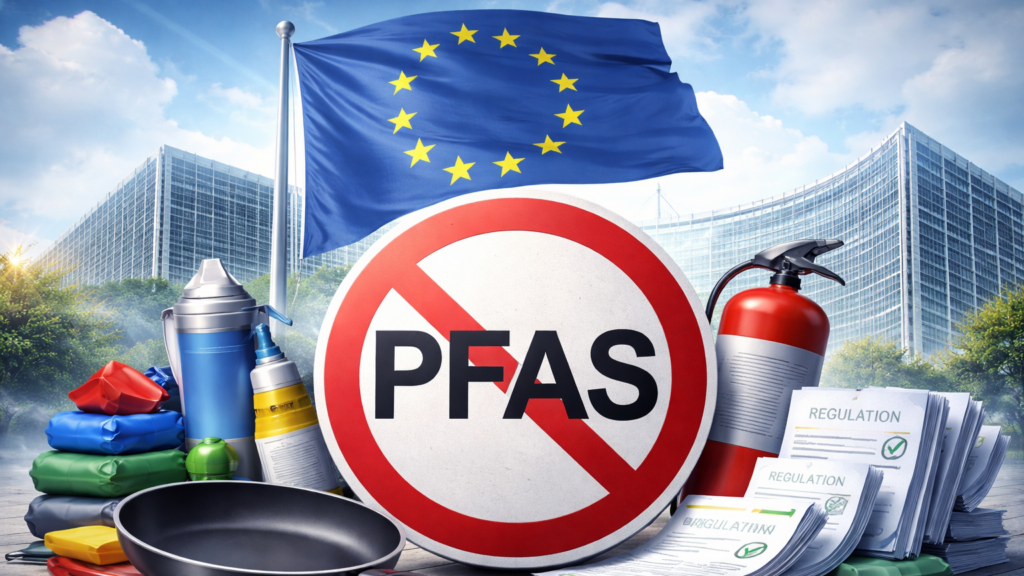
The European Union continues to work on the regulation of PFAS. After Germany, Denmark, the Netherlands, Norway and Sweden submitted a comprehensive restriction proposal in January 2023, the European Chemicals Agency (ECHA) published a revised version of the draft on 20 August 2025.
Revised Version Takes Objections into Account and Introduces Exemptions
The revised version addresses additional areas of application and thereby expands the scope of the planned REACH restriction. In certain cases, however, it also opens the door to exemptions. In addition, numerous deadlines have been extended, and for key future technologies such as semiconductors, a new option has been introduced allowing the use of PFAS-containing products for an unlimited period of time. Furthermore, the industrial or commercial use of PFAS-containing lubricants is now expected to remain unrestricted for more than a decade.
RAC and SEAC Assess Risks and Impacts
The scientific committees of ECHA – RAC (Risk Assessment Committee) and SEAC (Socio-Economic Analysis Committee) – are expected to deliver their final opinions by the end of 2026. A targeted public consultation on the SEAC draft is also planned for spring 2026. During this phase, companies, associations and stakeholders will be able to submit their assessments regarding economic impacts and practical feasibility.
First Partial Ban Enters into Force: PFAS in Firefighting Foams
On 29 April 2025, the EU Member States adopted a ban on PFAS in firefighting foams. This marks the first time that the use of all PFAS is prohibited in a specific field of application – a clear signal for the future regulatory approach to this group of substances. Depending on the area of use, different transitional periods apply.
Public Support, Economic Concerns
Public debate on the issue is intense: more than 5,000 comments were submitted to ECHA in 2023 alone. Environmental organisations are calling for far-reaching restrictions, while industry representatives warn of significant consequences for supply chains, research and innovation. The Federation of German Industries (BDI) advocates a more risk-based approach and exemptions for essential applications.
Greater Consensus Among the Public Than Among Industry Associations
A survey published by BUND around a year ago shows that three out of four respondents support a Europe-wide ban on PFAS – even contrary to the assessment of many experts, who argue that numerous industrial applications cannot be substituted without PFAS in the short term. This poses considerable challenges for manufacturers and distributors of the affected products, requiring time, effort and innovation.
Transitional Periods and Alternatives Are Key
With the expected opinions of the committees, the political decision by the European Commission is drawing closer. By the end of 2026, the framework conditions are expected to be defined – including possible exemptions and sector-specific transitional arrangements. For Costenoble, this means preparing substitution strategies at an early stage in order to remain capable of action in the future.
Costenoble: New Products in the Portfolio and Proven Solutions for New Applications
This substitution strategy includes the introduction of new PFAS-free or PFAS-reduced products into the portfolio in order to offer alternative solutions for existing applications in the future. At the same time, current applications are being reviewed to determine whether existing PFAS-free products from Costenoble can already achieve comparable results and replace established formulations.
Alongside its own development efforts, Costenoble continues to work closely with its long-standing partners DuPont and Chemours on new product solutions. At the same time, cooperation with new suppliers – such as the French company Lubrilog – is being expanded in order to further future-proof the overall product portfolio. Costenoble is currently on a very positive path and looks ahead with confidence to upcoming developments in the European Union’s approach to PFAS, with the clear objective of actively shaping the transition to environmentally compatible alternatives in the best interests of its customers.